Category Archives: Posts

The Piano Maker by Kurt Palka

Two-hundred eighty-eight pages. Published by McClelland & Stewart.

pianomakerimageThe bot-boiler that almost was. That’s the best way to sum up this sixth novel by Canadian author Kurt Palka. The last third of the book makes slogging through the first two-thirds worthwhile. If the author wrote the rest of the novel in such vivid colour as he did the courtroom drama and Canadian North flashbacks, this would be a potboiler, but it isn’t.

All the ingredients are there; World War 1, forbidden love, love lost, unrequited love, exotic travels and dangerous business liaisons. Instead, we’re treated to the plain tale of a middle-age French-born piano maker, Hélène Giroux. Her youth is marred by the war, as she learns to manage the family’s piano business. An encounter with an American scoundrel/businessman Nathan Homewood at first appears to salvage what’s left of the ruined business but the ultimate price Hélène pays is far greater than either of them could have imagined.

The book opens in the 1930s when Hélène arrives in a fictional Nova Scotia town to apply for the position of a church pianist. Through flashbacks and veiled references, we learn that Hélène is evading a secret past that involves, a death, a mental institution, a deformed foot and an illicit trade. All this should make for an enticing narrative but Palka’s rendering is muted and even dull.

Hélène’s past catches up with her when an RCMP officer informs Hélène she’s being arrested for the death of her former business partner. She was cleared of any wrong doing in a previous trial but new information comes to light.

Palka cranks it up a notch in the court room scenes with the thrilling telling of the events that led to her business partner’s death. Almost suddenly, we learn the strength, courage and resourcefulness Hélène hides from view. I couldn’t put the book down at this point.

If you rip through novels in days, then add this to your list. If you only manage to find the time to read the occasional novel, wait for something more captivating.
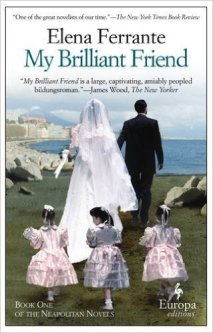
My Brilliant Friend by Elena Ferrante, translated by Ann Goldstein

Three-hundred-thirty-one pages, published by Europa Editions


brilliant-friendI kept walking past this book at Chapters and picking it up to scan. I was taken by the title and  intrigued by the synopsis. I was going to make it my book club pick when another member beat me to it.
All the online reviews call it a masterpiece. I think the publisher called it that and everyone jumped on board. While it’s definitely an excellent read and worth savoring some carefully crafted passages, I would say “masterpiece” is an indulgence. Having said that, once you pass the mid-point of the novel, the first of a trilogy, you’ll have trouble putting it down until you’ve finished it. But first, you have to get there.

The first half is slow and explanative, building each character’s profile and motivation. There’s a reason there’s a cast of characters listed at the front of the book, it reads like a soap opera. You must keep track of everyone, who they’re related to and whom they like.

The book opens when the two main characters are in their 60s. Elena receives a phone call informing her Lila appears to have gone missing on purpose. The narrator Elena, now a successful author, recounts their story. Elena and Lilia are two poor young girls growing up in dirty and brutal Naples in the 1950s. They form an unlikely bond that ebbs and flows. They grow up, the world around them changes and they’re forced into separate pursuits. Theirs is a pseudo-friendship based at times on jealousy, love, admiration, necessity and rivalry. In other words, it’s complicated.

The first novel (and I haven’t read the other three) begins before the girls are school-age and already daring each other and using violence in their endeavours and ends at the teenage wedding of one. Lilia is beautiful, brilliant and creative. She’s envied. Her intelligence surpasses that of her classmates but she’s denied an education. Short and plump Elena is smart but works hard to be Lila’s equal, yet real opportunity never befalls Lilia the way it does Elena.

Boys and relationships with them take centre stage as the girls mature. Elena and Lilia measure their intellect against them and seek to be with them as a sign of their success and popularity. Lila uses her will and talent to try to design a way out of her lot. Just when it seems she’ll be victorious, it all comes crashing down on the day that’s supposed to be one of her happiest.

Ferrante made me feel the betrayal and stinging rage Lila feels in the final pages. Her words are prose. However, from time to time, the translation from Italian was wordy and sentence structures convoluted. The book ends on a cliff hanger that makes you want to pick up the next book in the series.

All the Light We Cannot See by Anthony Doerr

Five-hundred-forty-four pages, Scribner.


f_doerr_allthelight_fMy first thought was, not another book about war. I seem to have read so many for my book club lately. However, just a handful of pages into this Pulitzer Prize winning novel, pre-conceived notions evaporated and I became immersed in Doerr’s vivid storytelling.

This is the tale of a blind French girl and a gifted German boy whose lives intersect during the war. Marie-Laure is a young girl living in Paris with her father at the cusp of Germany’s invasion of France. Six-year-old Marie-Laure is losing her eyesight as her single father does his best to raise her in a world cruel to those with disabilities. He builds a miniature reconstruction of their neighbourhood so she can find her way. Marie-Laure’s blindness doesn’t deter her curious mind and growing intellect. Her days are spent at the Museum of Natural History where her father is a talented locksmith.

The German invasion has the pair scrambling for the relative safety of the walled town of St. Malo where her great uncle lives. Her father appears to be entrusted with an item of extreme cultural importance and monetary value. He hides this object in an intricate wooden puzzle box and takes it with them to St. Malo. Marie-Laure becomes the owner of the puzzle box when her father disappears. The arduous journey to St. Malo is the beginning of an innocent girl’s recruitment into the dangerous resistance movement that at turns risks her life and saves it.

As Marie-Laure’s marvelous story unfolds, we read a parallel tale about a young boy named Werner who lives in an orphanage in Germany. He develops the ability to fix and make radios. His talents at first rescue him from a life of poverty, the destiny that awaits all the children at the orphanage. Gradually, his eagerness to please and brilliant mind end up being harnessed by the brutal Third Reich. Chapter by chapter, events in each character’s life bring them one step closer to their fateful encounter.

Simply told and elegantly written, this tale seized me by the heart as it drew images of goodness, evil and the shifting margin that separates them. Though Marie-Laure is blind for most of the novel, she sees more than others. The ability to sense good and bad saves her when not only does the war turn up on her doorstep but forces itself inside.

While touched by Marie-Laure’s narrative, I was sickened by Werner’s transformation from sympathetic and endearing boy to a Nazi soldier tasked with unspeakable missions. Marie-Laure and Werner’s stories equally crushed my heart and made my spirit soar.

Remarkable Restaurant Names Part 2

In the first RRN post, I posted photos of some of the quirky and fun names of restaurants I spotted in San Diego, California and mentioned that Halifax, Nova Scotia is right up there with San Diego in terms of memorable restaurant names.

Well folks, I’ve dug up pictures from my last stay in Nova Scotia and the words ‘businesses that serve food’ are more accurate to describe what I saw. The make-me-smile names belong to food trucks, cafés as well as restaurants and bars.

The one picture I didn’t take is of a bar called My Apartment. I wish I had. Imagine meeting someone and asking them if they would like to go back to ‘My Apartment’ to continue talking! The fun you can have with words.

If you’re reading this in Halifax, and My Apartment is still in business, send me a picture and I’ll post it.

Here are photos of creatively names places to grab a bite in Halifax, Nova Scotia. They are: The Daily Grind (coffee shop), Alfredo, Weinstein and Ho ( a multicultural buffet) and Bud the Spud French-fry food truck.

DailyGrind2AlWiHo

Cell Phone Debate

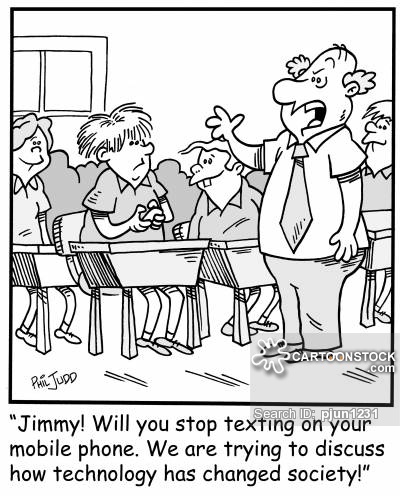
'Jimmy! Will you stop texting on your mobile phone. We are trying to discuss how technology has changed society!'

I’ve been back-to-school shopping as a mom for many years but this year presented a first. Among the new shoes, socks and school supplies was a cell phone. Not a request from the school but a request from my son and his father. I lost the battle to not buy a cell phone a while ago.

Does a boy who takes a school bus to and from school and gets driven pretty much everywhere really need a phone?  Logic outweighed desire this time. I thought a flip phone might be a compromise. After all, I still used one and it served my needs to talk and text. Unfortunately, that debate was also lost two to three when hubby declared that, “no one uses a flip phone anymore except you.” Since he works for a telecom provider, I knew then that both our son and I would be shopping for cells phones. I would not be out-teched by a 12 year-old.

It turns out that after a short while, all cell phones look alike and can pretty much do the same things. It’s all about the plans. Data plans. The plans can cause you to lose sleep and prompt you to create a spread sheet to compare all the plans and rates available. Do you want unlimited talk and text or just after 5 pm? How about weekends? How many megabytes do you need? Does a 12 year-old need any? Will he rely on Wi-Fi networks or use his own data plan?

Many hours later, with two new smart phones in hand; one iPhone with a data plan and one Android without, we headed home to program these things and draw up a shopping list of real school supplies – old fashioned pens, pencils and erasers. These are a few of my favourite things.

The first day of school crept upon us like we weren’t expecting it. It went like this: Really, I have to set my alarm for 5:50 a.m.? My first-time high schooler is keen, dressed early and ready to leave on time. I drive him to the bus stop and watch him board the bus from a distance so no one will know we’re together. I notice he’s wearing the school front-zip sweater and remark to myself that it’s going to be a warm day and he’s going to ditch the sweater at some point. Do I text him on the bus to remind him to keep his stuff together? No! I will not become that mother! I will not text my son on his first day of high school. How silly is that?

At recess time I text, “how’s it going?” He never replies. I can’t believe I did that. I text my husband to tell him of my irrational behaviour and he texts back that I beat him to it! What’s become of me? Of us? What did my mother do on my first day of high school? I phone and ask her. She says she can’t remember and frankly, neither can I. My son does text me from the bus in the afternoon to give me blow-by-blow details of the bus’s progress through traffic.

The first day of high school has come and gone. My son got off the bus at the end of the day without his school sweater, which I assumed was in his backpack. I was wrong. He couldn’t remember where he left it. The first day of school and already an item misplaced. Some things don’t change.