Tag Archives: book club ideas

The Story of a New Name by Elena Ferrante

Europa Editions, four hundred and seventy one pages (translated by Ann Goldstein).
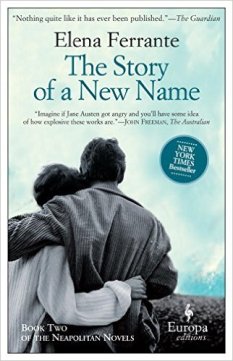
51w00tgvxtl-_sx320_bo1204203200_The Story of a New Name is so addictive; you can’t put it down. This is the second installment in Elena Ferrante’s Neapolitan chronicles. It’s so much better than the first, My Brilliant Friend. The novel starts where the first one ends – at Lina’s wedding, when she discovers her new husband has already betrayed her.

The soap opera list of characters already established, Ferrante is able to dive into the action in a way the first novel lacks. There’s much less set-up and character back-stories. Ferrante gets right to it and so much actually happens to her beloved duo of Lina and Elena. Lina’s honeymoon is a horror and her newly-wed life never really amounts to more than that. Elena finds success and a somewhat dubious mate.

A good chunk of the novel takes place at the beach where Lina and Elena spend the summer in the hopes of Lina becoming pregnant during one of Stefano’s visits. Plenty of actual sex and thinking about sex takes place at the beach. Lina takes a lover and in a fit of jealousy, Elena decides she’s done with being a virgin and does something drastic and terrible. Elena seems to be suffocating in Lina’s shadow. She believes Lina is sophisticated and intelligent but the ignorance and naiveté of both girls is at times frightening.

Since Elena is narrating the story, and she is infatuated, if not actually in love with Lina, much of the grandiose story-telling is centered around Lina while Elena’s tale is more sombre. This is clearly how Elena sees her own life. She says she’s happy but Elena is unable to tear herself away from Lina, even when Lina appears to implode. Lina is the proverbial traffic accident and Elena is the rubber-necker who can’t move along and eventually gets involved in the accident.

That makes me a voyeur and a speed-reader.

Life After Life by Kate Atkinson

Five hundred-forty-four pages. Published by Hachette.

Yogi Berra uttered the redundant phrase, “it’s déja vu all over again,” and made it funny. There’s nothing fun about reading author Kate Atkinson’s book about déja vu all over again. Other books and movies based on the idea; The Time Traveler’s Wife and Groundhog Day come to mind, do a better job of making the time-shift paradigm enjoyable.

life-after-lifeIn Life After Life, the main character, Ursula Todd, is born on February 11, 1910. She dies at birth only to be born again and again on the exact night with different life outcomes the result of each re-birth. The book is not quite about reincarnation as it is about getting to relive your life over and over again until you get it right.

As Ursula, the precocious child in an upper-class home in the English countryside grows up, she is either raped in her home and lives with the gut-wrenching consequences or slaps her would-be rapist avoiding any second encounter; she either saves a young neighbour from a sexual predator, nearly becomes one of his victims or helps search for the missing girl; Ursula either becomes a confidant of Eva Braun or shoots Hitler herself before the war even begins.

Atkinson writes the story in a way that pivotal occasions in Ursula’s life are re-written over and over again with seemingly small but significant differences. For example, an encounter with two old ladies on a stairwell is re-written at least three times with the identical descriptions and conversations with one slight difference each time. Yet, the end results are the same. This section of the book feels like it was cut and pasted over and over again. I found it annoying to re-read.

Ursula not only has the ability to be re-born at the moment of her birth, she can jump out of windows as a teen and have a building fall upon her as an adult, die and come back again. This is where the book got murky, I wasn’t sure if Ursula’s varied deaths meant that she had to go back to her moment of birth and start over and ultimately, I didn’t know which of lives was her final one. Or, does she keep re-living her life forever?

This should have been an intriguing read full of what-ifs and if-onlys but despite its numerous awards, wasn’t.

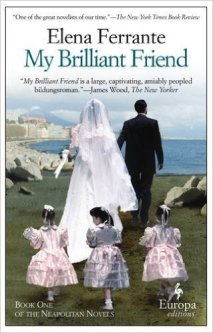
My Brilliant Friend by Elena Ferrante, translated by Ann Goldstein

Three-hundred-thirty-one pages, published by Europa Editions


brilliant-friendI kept walking past this book at Chapters and picking it up to scan. I was taken by the title and  intrigued by the synopsis. I was going to make it my book club pick when another member beat me to it.

All the online reviews call it a masterpiece. I think the publisher called it that and everyone jumped on board. While it’s definitely an excellent read and worth savoring some carefully crafted passages, I would say “masterpiece” is an indulgence. Having said that, once you pass the mid-point of the novel, the first of a trilogy, you’ll have trouble putting it down until you’ve finished it. But first, you have to get there.

The first half is slow and explanative, building each character’s profile and motivation. There’s a reason there’s a cast of characters listed at the front of the book, it reads like a soap opera. You must keep track of everyone, who they’re related to and whom they like.

The book opens when the two main characters are in their 60s. Elena receives a phone call informing her Lila appears to have gone missing on purpose. The narrator Elena, now a successful author, recounts their story. Elena and Lilia are two poor young girls growing up in dirty and brutal Naples in the 1950s. They form an unlikely bond that ebbs and flows. They grow up, the world around them changes and they’re forced into separate pursuits. Theirs is a pseudo-friendship based at times on jealousy, love, admiration, necessity and rivalry. In other words, it’s complicated.

The first novel (and I haven’t read the other three) begins before the girls are school-age and already daring each other and using violence in their endeavours and ends at the teenage wedding of one. Lilia is beautiful, brilliant and creative. She’s envied. Her intelligence surpasses that of her classmates but she’s denied an education. Short and plump Elena is smart but works hard to be Lila’s equal, yet real opportunity never befalls Lilia the way it does Elena.

Boys and relationships with them take centre stage as the girls mature. Elena and Lilia measure their intellect against them and seek to be with them as a sign of their success and popularity. Lila uses her will and talent to try to design a way out of her lot. Just when it seems she’ll be victorious, it all comes crashing down on the day that’s supposed to be one of her happiest.

Ferrante made me feel the betrayal and stinging rage Lila feels in the final pages. Her words are prose. However, from time to time, the translation from Italian was wordy and sentence structures convoluted. The book ends on a cliff hanger that makes you want to pick up the next book in the series.