
Tag Archives: book club

All the Light We Cannot See by Anthony Doerr

Five-hundred-forty-four pages, Scribner.
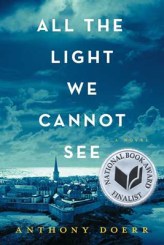
 

f_doerr_allthelight_fMy first thought was, not another book about war. I seem to have read so many for my book club lately. However, just a handful of pages into this Pulitzer Prize winning novel, pre-conceived notions evaporated and I became immersed in Doerr’s vivid storytelling.

This is the tale of a blind French girl and a gifted German boy whose lives intersect during the war. Marie-Laure is a young girl living in Paris with her father at the cusp of Germany’s invasion of France. Six-year-old Marie-Laure is losing her eyesight as her single father does his best to raise her in a world cruel to those with disabilities. He builds a miniature reconstruction of their neighbourhood so she can find her way. Marie-Laure’s blindness doesn’t deter her curious mind and growing intellect. Her days are spent at the Museum of Natural History where her father is a talented locksmith.

The German invasion has the pair scrambling for the relative safety of the walled town of St. Malo where her great uncle lives. Her father appears to be entrusted with an item of extreme cultural importance and monetary value. He hides this object in an intricate wooden puzzle box and takes it with them to St. Malo. Marie-Laure becomes the owner of the puzzle box when her father disappears. The arduous journey to St. Malo is the beginning of an innocent girl’s recruitment into the dangerous resistance movement that at turns risks her life and saves it.

As Marie-Laure’s marvelous story unfolds, we read a parallel tale about a young boy named Werner who lives in an orphanage in Germany. He develops the ability to fix and make radios. His talents at first rescue him from a life of poverty, the destiny that awaits all the children at the orphanage. Gradually, his eagerness to please and brilliant mind end up being harnessed by the brutal Third Reich. Chapter by chapter, events in each character’s life bring them one step closer to their fateful encounter.

Simply told and elegantly written, this tale seized me by the heart as it drew images of goodness, evil and the shifting margin that separates them. Though Marie-Laure is blind for most of the novel, she sees more than others. The ability to sense good and bad saves her when not only does the war turn up on her doorstep but forces itself inside.

While touched by Marie-Laure’s narrative, I was sickened by Werner’s transformation from sympathetic and endearing boy to a Nazi soldier tasked with unspeakable missions. Marie-Laure and Werner’s stories equally crushed my heart and made my spirit soar.

Where’d You Go Bernadette by Maria Semple

Where’d You Go Bernadette by By Maria Semple.

Three-hundred-and-thrity pages, Little, Brown and Company.

bernadetteBernadette Fox is someone I’d love to know. She’s the main character in the novel and she’s original, creative, sarcastic, edgy and a little crazy. I just wouldn’t want to be her.

We meet Bernadette as the doting but eccentric mother to impressionable young Bee, a 15 year-old girl attending a tony private school in Seattle. Bernadette doesn’t get along with the other moms who she calls gnats, is a semi-recluse and the wife of a Microsoft star. She spends her days writing in a Gulfstream trailer parked outside her house while her partner climbs to greatness.

When Bernadette promises Bee a trip to Antarctica if she brings home a straight A report card, Bernadette never imagines her daughter could pull it off. She does and the quirky, unorthodox planning, which involves a virtual assistant in India, ensues. But before the epic trip to Antarctica can take place, Bernadette mysteriously disappears and we wonder if she’ll ever return.

Bee’s obsessive search for her mother takes her and her father to the end of the world and back. Much of the book rests on the mother-daughter relationship and unconditional love. You’re more than halfway through the book before you discover Bernadette’s genius and what began her toying with madness.

The droll, laugh-out-loud and at times serious story is told in emails, letters and FBI correspondence among other formats. Author Maria Semple evokes the wit and sarcasm of comedian Ellen De Generes and that’s no surprise since she’s a former writer for the TV show, Ellen, staring De Generes. Semple sends up the Subaru-driving, over-achieving, environmentally-concerned, politically correct, status conscious suburban moms of Seattle to the point of caricature.

I couldn’t put this one down folks. It’s a compulsive read.

Book Review: The Cellist of Sarajevo by Steven Galloway

cellist.jpgPutting a face on the horrors of war and celebrating determination are the hallmarks of the Cellist of Sarajevo. There are actually three faces here and the book’s chapters skip from person to person to person and their individual struggles with the Bosnian war. The three main characters never meet and lead completely separate lives in Sarajevo.

Kenan is a husband and father who is stripped of the ability to work and earn a living. He now fetches fresh drinking water weekly for his family. Each treacherous journey may be his last. Dragan is an older man who has hung on to his job at a bakery and lives with his sister and her family, having sent his own family to safety in Italy. Arrow is an unlikely army recruit; a reluctant sharpshooter who chooses her own targets.

The three protagonists have one thing in common: They risk their lives to watch the cellist of Sarajevo perform Albinoni’s Adagio weekly in a public square. The sad slow piece is the cellist’s personal tribute to the 22 souls who lost their lives standing in line for bread when they came under mortar fire.

This is a fictional account of real life cellist Vedran Smailović who did actually play Albinoni’s Adagio and other classical pieces among the ruins of Sarajevo. That’s where reality ends and Galloway’s imagination takes over as he creates characters living around the unnamed cellist’s weekly performances.

Galloway writes clearly and simply with vivid details of life’s daily struggles in a city under siege but only one character really engaged me and she is Arrow. Galloway delves into her mind to explain her internal conflict with her role in the war. I wanted to know more about her. With Clint Eastwood’s movie American Sniper currently glorified in the media, Galloway’s more complicated, darker and ultimately hopeless portrait has an opposite effect.

For me, Arrow saved this book.

Book Review, The World We Found by Thrity Umrigar

Indian-American author Thrity Umrigar’s The World We Found does for middle-age women what The Sisterhood of the Travelling Pants did for teenage girls – use powerful experiences to create ageless friendships. Umrigrar has taken chick lit and steeped it in a potent brew.

world-we-foundThe novel is about how the dying wish of one woman leads to secrets exposed, acknowledging present disappointments and ultimately betrayal.  Armaiti is the character whom the story is centered around. She’s a transplanted Indian who left her country for post-grad studies in the States, ends up marrying locally and builds a life stateside. Her sudden grim prognosis moves her to contact her old college girlfriends back in India, who she hasn’t seen in 30 years, and ask them to visit her. It’s an unlikely beginning but Umrigar’s capable story telling makes it believable.

However, my book club pretty much agreed that we were left not understanding some of the actions and motivations of the leading characters – Armaiti and her gal pals Laleh, Nishta and Kavita. One married rich, betraying the socialist cause they once fought for, another leads a secret life, while the third is lead into an ultra-conservative Muslim existence.

The book is about the journey of overcoming 20 years of separateness and reconciling with choices made in life, rather than a grand reunion. In this book, Umrigar’s story telling is greater than her character building. If strong character development is your preference, then Umrigar’s The Space Between Us is for you.

Book review of The Girl Who Was Saturday Night by Heather O’Neill

This novel was eagerly anticipated by my book club, which read O’Neill’s previous offering; Lullabies for Little Criminals and generally loved it. We were disappointed.

the-girl-who-was-saturday-nightAs the person who chose the book, I read the online reviews, which are all glowing and appreciative of O’Neill’s quirky metaphoric prose so I expected a stellar read. However, the book’s storyline and writing style left us underwhelmed.

The Girl Who Was Saturday Night is only O’Neill’s second novel since her runaway success Lullabies for Little Criminals came out 7 years ago. And similarly, it’s about a lost girl living on the wrong side of town who eventually finds her place, if not in the sun, then in a warmer spot.

This time the heroine is a French Canadian teen named Nouschka who lives with her twin brother Nicolas and their ailing grandfather Loulou on the seedy side of St. Laurent Blvd. because they’ve been abandoned by both parents – a teenage girl and a famous French Canadian chansonnier. The book is written in English but we’re to imagine the language spoken is French and to remind us of that, O’Neill adds French phrases seemingly randomly throughout the book.

The story takes place during Quebec’s second failed referendum for sovereignty in 1995 and I’m left wondering if the referendum is a metaphor for the failed lives so-far of the two protagonists. Their dreams are wild and magnificent, but their fulfillment, just like sovereignty itself, eludes them.

Through poor life-choices like dropping out of school, marrying the wrong man, aiding in a bank robbery, using drugs and indiscriminate sex, Nouschka’s life spirals out of control until an event changes her path ever so slowly and she pieces her life together. Nouschka’s love of and talent for writing saves her soul from the dead streets of downtown Montreal.  O’Neill had a hard-scrabble life as a youth and I wonder how much of O’Neill’s actual life figures in this novel.

O’Neill’s penchant for metaphor and simile is rampant. I underlined about a hundred metaphors and similes, fascinated by how she compares unrelated elements to describe everything from the countless cats that appear in the book to her character descriptions. While I enjoyed this, the majority of the book club didn’t.

I wanted to like this book, but don’t.  However, it’s an excellent choice for a book club selection because you will be discussing her use of metaphors, plot twists and character development for hours.