
Published by Crown. Three-hundred and thirty-seven pages.
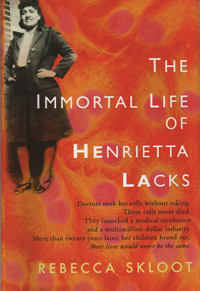 Henrietta Lacks was a poor, barely-educated African-American woman from the South. Her cells were taken by her physician while she was battling cancer. Those cells live on to this day and are said to be responsible for many medical breakthroughs like the polio vaccine. This biography is her story and the story of her children’s lives after her death.
Lacks, who died in 1951, never gave consent for her cells to be taken and her family has never been compensated for their use. Skloot tells us millions if not billions of dollars have been made by the pharmaceutical industry making more of, selling and testing her cells. Typically, our cells die after a period of time outside our bodies. For some reason, Lacks’ cells never die.
The science is fascinating but her story is tragic. Skloot’s book raises more questions than it answers. Was Lacks’ medical treatment inferior to that of white people’s of the era? Was the reason no consent was attempted, and no attempt made to inform her family, because she was black? Her offspring suffered greatly as children and continued to suffer as adults. They were shocked and confused to learn about their mother’s cells, known around the world by scientists as HeLa.
We learn, alarmingly, that Lacks may have been the first, but not the last person whose cells have been taken by doctors for research without patient consent. Various American courts have upheld the right of doctors and scientists to use people’s cells without compensation to the donor. The reason is invariably that doing so would stagnate medical research. Skloot does a good job of outlining various stakeholders’ arguments for and against that reasoning.
The author, a science writer, unearths a mountain of scientific practices that continue today and affect us one and all.
 More than not bad for a debut novel. This New York Times best seller, alluring and electrifying, will send you rushing to Google to check out the facts behind the real Manson Murders.
 The novel is about how the dying wish of one woman leads to secrets exposed, acknowledging present disappointments and ultimately betrayal. Armaiti is the character whom the story is centered around. She’s a transplanted Indian who left her country for post-grad studies in the States, ends up marrying locally and builds a life stateside. Her sudden grim prognosis moves her to contact her old college girlfriends back in India, who she hasn’t seen in 30 years, and ask them to visit her. It’s an unlikely beginning but Umrigar’s capable story telling makes it believable.
 Silvia Wrote It