
Tag Archives: book review

The Story of a New Name by Elena Ferrante

Europa Editions, four hundred and seventy one pages (translated by Ann Goldstein).
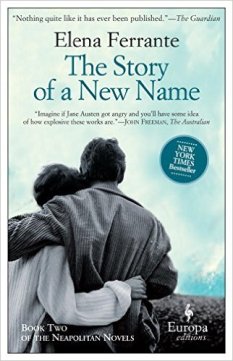
51w00tgvxtl-_sx320_bo1204203200_The Story of a New Name is so addictive; you can’t put it down. This is the second installment in Elena Ferrante’s Neapolitan chronicles. It’s so much better than the first, My Brilliant Friend. The novel starts where the first one ends – at Lina’s wedding, when she discovers her new husband has already betrayed her.

The soap opera list of characters already established, Ferrante is able to dive into the action in a way the first novel lacks. There’s much less set-up and character back-stories. Ferrante gets right to it and so much actually happens to her beloved duo of Lina and Elena. Lina’s honeymoon is a horror and her newly-wed life never really amounts to more than that. Elena finds success and a somewhat dubious mate.

A good chunk of the novel takes place at the beach where Lina and Elena spend the summer in the hopes of Lina becoming pregnant during one of Stefano’s visits. Plenty of actual sex and thinking about sex takes place at the beach. Lina takes a lover and in a fit of jealousy, Elena decides she’s done with being a virgin and does something drastic and terrible. Elena seems to be suffocating in Lina’s shadow. She believes Lina is sophisticated and intelligent but the ignorance and naiveté of both girls is at times frightening.

Since Elena is narrating the story, and she is infatuated, if not actually in love with Lina, much of the grandiose story-telling is centered around Lina while Elena’s tale is more sombre. This is clearly how Elena sees her own life. She says she’s happy but Elena is unable to tear herself away from Lina, even when Lina appears to implode. Lina is the proverbial traffic accident and Elena is the rubber-necker who can’t move along and eventually gets involved in the accident.

That makes me a voyeur and a speed-reader.

Life After Life by Kate Atkinson

Five hundred-forty-four pages. Published by Hachette.

Yogi Berra uttered the redundant phrase, “it’s déja vu all over again,” and made it funny. There’s nothing fun about reading author Kate Atkinson’s book about déja vu all over again. Other books and movies based on the idea; The Time Traveler’s Wife and Groundhog Day come to mind, do a better job of making the time-shift paradigm enjoyable.

life-after-lifeIn Life After Life, the main character, Ursula Todd, is born on February 11, 1910. She dies at birth only to be born again and again on the exact night with different life outcomes the result of each re-birth. The book is not quite about reincarnation as it is about getting to relive your life over and over again until you get it right.

As Ursula, the precocious child in an upper-class home in the English countryside grows up, she is either raped in her home and lives with the gut-wrenching consequences or slaps her would-be rapist avoiding any second encounter; she either saves a young neighbour from a sexual predator, nearly becomes one of his victims or helps search for the missing girl; Ursula either becomes a confidant of Eva Braun or shoots Hitler herself before the war even begins.

Atkinson writes the story in a way that pivotal occasions in Ursula’s life are re-written over and over again with seemingly small but significant differences. For example, an encounter with two old ladies on a stairwell is re-written at least three times with the identical descriptions and conversations with one slight difference each time. Yet, the end results are the same. This section of the book feels like it was cut and pasted over and over again. I found it annoying to re-read.

Ursula not only has the ability to be re-born at the moment of her birth, she can jump out of windows as a teen and have a building fall upon her as an adult, die and come back again. This is where the book got murky, I wasn’t sure if Ursula’s varied deaths meant that she had to go back to her moment of birth and start over and ultimately, I didn’t know which of lives was her final one. Or, does she keep re-living her life forever?

This should have been an intriguing read full of what-ifs and if-onlys but despite its numerous awards, wasn’t.

The Piano Maker by Kurt Palka

Two-hundred eighty-eight pages. Published by McClelland & Stewart.

pianomakerimageThe bot-boiler that almost was. That’s the best way to sum up this sixth novel by Canadian author Kurt Palka. The last third of the book makes slogging through the first two-thirds worthwhile. If the author wrote the rest of the novel in such vivid colour as he did the courtroom drama and Canadian North flashbacks, this would be a potboiler, but it isn’t.

All the ingredients are there; World War 1, forbidden love, love lost, unrequited love, exotic travels and dangerous business liaisons. Instead, we’re treated to the plain tale of a middle-age French-born piano maker, Hélène Giroux. Her youth is marred by the war, as she learns to manage the family’s piano business. An encounter with an American scoundrel/businessman Nathan Homewood at first appears to salvage what’s left of the ruined business but the ultimate price Hélène pays is far greater than either of them could have imagined.

The book opens in the 1930s when Hélène arrives in a fictional Nova Scotia town to apply for the position of a church pianist. Through flashbacks and veiled references, we learn that Hélène is evading a secret past that involves, a death, a mental institution, a deformed foot and an illicit trade. All this should make for an enticing narrative but Palka’s rendering is muted and even dull.

Hélène’s past catches up with her when an RCMP officer informs Hélène she’s being arrested for the death of her former business partner. She was cleared of any wrong doing in a previous trial but new information comes to light.

Palka cranks it up a notch in the court room scenes with the thrilling telling of the events that led to her business partner’s death. Almost suddenly, we learn the strength, courage and resourcefulness Hélène hides from view. I couldn’t put the book down at this point.

If you rip through novels in days, then add this to your list. If you only manage to find the time to read the occasional novel, wait for something more captivating.

Where’d You Go Bernadette by Maria Semple

Where’d You Go Bernadette by By Maria Semple.

Three-hundred-and-thrity pages, Little, Brown and Company.

bernadetteBernadette Fox is someone I’d love to know. She’s the main character in the novel and she’s original, creative, sarcastic, edgy and a little crazy. I just wouldn’t want to be her.

We meet Bernadette as the doting but eccentric mother to impressionable young Bee, a 15 year-old girl attending a tony private school in Seattle. Bernadette doesn’t get along with the other moms who she calls gnats, is a semi-recluse and the wife of a Microsoft star. She spends her days writing in a Gulfstream trailer parked outside her house while her partner climbs to greatness.

When Bernadette promises Bee a trip to Antarctica if she brings home a straight A report card, Bernadette never imagines her daughter could pull it off. She does and the quirky, unorthodox planning, which involves a virtual assistant in India, ensues. But before the epic trip to Antarctica can take place, Bernadette mysteriously disappears and we wonder if she’ll ever return.

Bee’s obsessive search for her mother takes her and her father to the end of the world and back. Much of the book rests on the mother-daughter relationship and unconditional love. You’re more than halfway through the book before you discover Bernadette’s genius and what began her toying with madness.

The droll, laugh-out-loud and at times serious story is told in emails, letters and FBI correspondence among other formats. Author Maria Semple evokes the wit and sarcasm of comedian Ellen De Generes and that’s no surprise since she’s a former writer for the TV show, Ellen, staring De Generes. Semple sends up the Subaru-driving, over-achieving, environmentally-concerned, politically correct, status conscious suburban moms of Seattle to the point of caricature.

I couldn’t put this one down folks. It’s a compulsive read.

Book Review, The World We Found by Thrity Umrigar

Indian-American author Thrity Umrigar’s The World We Found does for middle-age women what The Sisterhood of the Travelling Pants did for teenage girls – use powerful experiences to create ageless friendships. Umrigrar has taken chick lit and steeped it in a potent brew.

world-we-foundThe novel is about how the dying wish of one woman leads to secrets exposed, acknowledging present disappointments and ultimately betrayal.  Armaiti is the character whom the story is centered around. She’s a transplanted Indian who left her country for post-grad studies in the States, ends up marrying locally and builds a life stateside. Her sudden grim prognosis moves her to contact her old college girlfriends back in India, who she hasn’t seen in 30 years, and ask them to visit her. It’s an unlikely beginning but Umrigar’s capable story telling makes it believable.

However, my book club pretty much agreed that we were left not understanding some of the actions and motivations of the leading characters – Armaiti and her gal pals Laleh, Nishta and Kavita. One married rich, betraying the socialist cause they once fought for, another leads a secret life, while the third is lead into an ultra-conservative Muslim existence.

The book is about the journey of overcoming 20 years of separateness and reconciling with choices made in life, rather than a grand reunion. In this book, Umrigar’s story telling is greater than her character building. If strong character development is your preference, then Umrigar’s The Space Between Us is for you.